Friends! This weekend in the Garden, let’s try a short form that’s less fussy and more adorable. It’s called the TRICUBE and the rules are super-simple: Each line contains three syllables, Each stanza contains three lines, and Each poem contains three stanzas.
That’s it! Except to say that the fun, mathematical tricube was created by Phillip Larrea.
Let’s try it. Three… two… one… Go!
Hello
Toads! For our little form challenge today, let’s try invoking the rule of
three in a form that allows for poems that are short or longer--the TERZA RIMA.
We’ve played with three in the Garden plenty of times--think triolet or
sevenling--but I don’t think we’ve tackled this form directly. It also follows
nicely from the chained rhyme we worked on last time, so let’s dig in.
The
terza rima has a long pedigree, having been created by Dante for The Divine
Comedy, but it is really quite simple in concept. Perhaps that is why it is so
long-lasting. It is a series of interlocking three-line stanzas in which the
end rhyme in the second line provides the rhyme for the first and third lines
of the next, like this: A-B-A, B-C-B, C-D-C and so on, to your
heart’s content.
Another famous example of terza rima with which you may be familiar:
“Acquainted with the Night” by Robert Frost
I have been one acquainted with the night. I have walked out in rain—and back in rain. I have outwalked the furthest city light.
I have looked down the saddest city lane. I have passed by the watchman on his beat And dropped my eyes, unwilling to explain.
I have stood still and stopped the sound of feet When far away an interrupted cry Came over houses from another street,
But not to call me back or say good-bye; And further still at an unearthly height, One luminary clock against the sky
Proclaimed the time was neither wrong nor right I have been one acquainted with the night.
Usually
the terza rima is written in iambic pentameter, but this is not required. It is
suggested that the lines be the same length or syllable count, but again, not
imperative. There is no limit to the number of stanzas one might include in a
terza rima. One can write a terza rima sonnet as Robert Frost did above, like
this: A-B-A, B-C-B, C-D-C, D-E-D, E-E
Academy of American Poets has a longer article at poets.org about terza rima that may be interesting or helpful: ARTICLE
As a sweet-special and totally inspiring added bonus, I found audio of dearest Adrienne Rich reading her poem titled “Terza Rima,” which flies far afield from the form and, of course, amazes: AUDIO
And here is a review of Arts of the Possible, Adrienne Rich's collection in which this poem appears: REVIEW
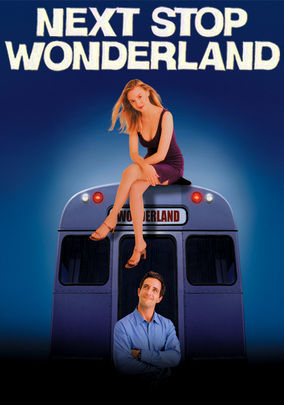
No, I am not talking about Alice, a white rabbit, or a Mad tea party, but you can use this book for the prompt-if you like. Today, I am sharing one of my favorite Indie flicks, Next Stop Wonderland, with the late Phillip Seymour Hoffman and Hope Davis. Have you seen this movie? Their union is a tangle of mixed metaphors and dreams. Hope Davis plays Erin, the main character-who is lost in a sea of sadness and prodded by her meddling, matchmaking mother. She and her boyfriend are doomed from the start. Her soul mate is constantly in her path, yet she doesn't see the signs-just yet.
There is a scene in the move, where Erin is in a bookstore and she drops a book on the floor. The elderly book seller sees her and offers this wisdom.
Bookseller: (after Erin Castleton has dropped the book) : Don't close it. You should never close a book until you've read something from it. Erin Castleton: What? Bookseller: Well, just a sentence or a word. It can be very, very revealing. Just read something, anything. Well, read from the top, then.
Today we are going to use this wisdom and be open to the wondrous possibilities-in randomly opening a book. Go grab three books and open each book three times and see what leaps out of you. Pick a sentence and play. Rearrange it, or grab a word that you catches your eye, or something off the page that captures your attention-a name or even number. Here are a few of my finds-you are welcome to use them-if you like~
I grabbed one of my husband's book, Gray Ghost. He loves mystery author, William G. Tapply.
"Calhoun woke up with gray light and a cacophony of birdsong seeping in through the bedroom window screen."
Here is a sentence from the book, Foolsgold by Susan G. Wooldridge:
"My neighbor Penny passes a tray of small earthenware pots, a kettle of soil, and four packets of seeds to symbolize what we wish to plant in our lives."
Here I have opened the book, Medicine Cards by Jamie Sams:
"Remember, the teacher or pathway may be the small still voice within, as well as a person, a leaf, a cloud, a stone, a tree, a book, or the Great Spirit."
From, The Story Sisters by Alice Hoffman:
"Most of the writing in the journal was Arnish, with captions beneath green and black watercolor paintings."
From, Elephant Winter by Kim Echlin: "When I closed my eyes I could see mandalas and carved saints and rough stone arches."
Pen a poem inspired by the serendipity of a found sentence, a word, or an image that surfaces as you glance across the page! Go grab some books and be guided by chance or use one of my sentences above to inspire you~
Congrats to those of you who are doing NaPoWriMo-this is the last leg(week) of your challenge-Cheers to you!!!